Most medicinal mushroom claims live in a frustrating gray zone: promising lab data, animal studies, traditional use, and a conspicuous absence of large human trials. Turkey Tail is the exception, and it is worth being precise about why.
Polysaccharide-K (PSK, marketed in Japan as Krestin) extracted from Trametes versicolor has been an approved adjuvant cancer therapy in Japan for more than three decades. Not a supplement occupying a regulatory gray area - an approved drug, prescribed alongside chemotherapy, with government health insurance coverage in Japan for specific cancer indications. That is a different category of evidence than almost anything else covered on this site, and it deserves to be treated with the seriousness it has actually earned.
What Is Turkey Tail?
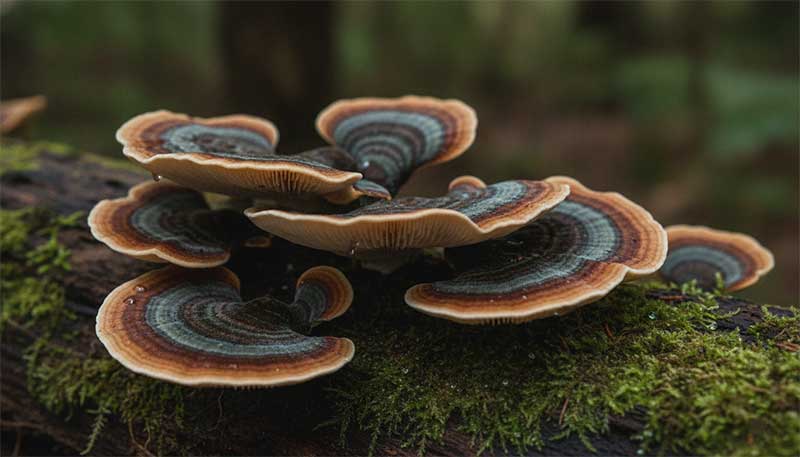
Trametes versicolor (also called Coriolus versicolor) is a thin, fan-shaped bracket fungus that grows in overlapping clusters on dead logs and stumps worldwide. The name comes from its concentric color bands - browns, creams, and blue-greens - that resemble a wild turkey's tail feathers. Unlike Reishi or Chaga, it does not require rare conditions to grow; it is one of the most common wood-decay fungi in temperate forests globally.
The two clinically relevant extracts are PSK and PSP (polysaccharide-peptide), both protein-bound polysaccharides derived from the mycelium, developed and standardized separately in Japan and China respectively. They share a similar structure and mechanism but were studied through somewhat different clinical research traditions.
The Compound: PSK and PSP
Developed and approved in Japan. The most clinically studied form, with the largest body of randomized controlled trial data, primarily in gastric and colorectal cancer as a chemotherapy adjuvant.
Developed independently in China from a different Trametes versicolor strain. Studied for similar immune-modulating and direct cytotoxic effects, with documented activity against non-small cell lung cancer progression.
Both compounds show a dual mechanism that makes them mechanistically interesting beyond just "immune support": direct cytotoxic activity against cancer cells in vitro, combined with genuine immune system stimulation - increasing lymphocyte counts, natural killer cell activity, and CD8+ T cell and CD19+ B cell counts in treated patients.
The Clinical Evidence: What Large Trials Actually Show
Gastric Cancer
A controlled trial of 349 stage II/III gastric cancer patients receiving adjuvant therapy after curative resection compared standard oral chemotherapy alone against chemotherapy plus PSK. The PSK group showed survival-prolonging effects, with the benefit concentrated in patients at high risk of recurrence - specifically those with lymph node metastasis and absent MHC class I expression. A separate trial of 254 gastric cancer patients evaluated PSK's effect on overall survival with similarly positive findings.
Colorectal Cancer
Multiple studies have found that colorectal cancer patients treated with PSK alongside chemotherapy showed better survival outcomes, with the evidence notably stronger for those taking PSK alongside oral chemotherapy specifically, compared to intravenous regimens. A randomised controlled study examining adjuvant immunochemotherapy with oral tegafur/uracil plus PSK in stage II/III colorectal cancer patients confirmed this pattern. A more recent 2024 trial directly compared UFT/LV chemotherapy alone, UFT/LV plus PSK, and a longer course of UFT/LV plus PSK in stage II/III colorectal cancer patients after surgical resection, tracking three-year survival outcomes.
Breast Cancer and Immune Markers
A small uncontrolled trial found that breast cancer patients treated with 6 grams of Turkey Tail mushroom daily after completing radiotherapy showed greater lymphocyte counts, natural killer cell activity, and CD8+ T cell and CD19+ B cell counts compared to their own baseline, with the effect increasing at higher doses. This is exactly the kind of immune-marker data that supports the adjuvant use case, separate from the direct survival data seen in gastric and colorectal cancer.
A Phase 2 pilot "window of opportunity" study sponsored by Mayo Clinic (NCT06450873) is actively recruiting postmenopausal women with HER2-negative, ER-positive breast cancer who are planning surgery. Participants take Coriolus versicolor extract before their operation, with researchers measuring the change in Ki-67 (a cell proliferation marker) between baseline and surgery. Enrollment target is 100 patients, with the study expected to complete in late 2026. This is meaningfully different from older retrospective or small uncontrolled studies - it is prospective, has a defined primary endpoint, and is being run at a major academic medical center.
Where the Evidence Gets Thinner
This is the section that separates Turkey Tail from supplement marketing, and it matters to be direct about it.
The strong human RCT evidence is specifically in the adjuvant oncology setting - PSK or PSP added to standard chemotherapy in patients who already have a cancer diagnosis and are receiving conventional treatment. It is not evidence that Turkey Tail prevents cancer in healthy people, treats cancer as a standalone therapy, or substitutes for chemotherapy, surgery, or radiation in any way.
For general immune support outside an active cancer context - the use case most people buying Turkey Tail supplements actually have - the evidence is considerably thinner. The mechanism (beta-glucan and polysaccharide-peptide immune modulation) is plausible and consistent with the broader medicinal mushroom category, but the large, well-controlled trials specifically exist in the oncology adjuvant population, not in healthy adults seeking a general immune boost.
Higher immune activation is not automatically beneficial in every cancer context, and Turkey Tail should never be added to a treatment regimen without direct physician involvement. PSK and PSP have real drug-like activity - they are not a neutral "natural" addition. If you or someone you know is considering this alongside conventional cancer treatment, the conversation needs to happen with the treating oncologist, not as a self-directed supplement decision.
Adjuvant Gastric & Colorectal Cancer
Multiple large RCTs (200-350+ patients) show survival benefits when PSK is added to standard chemotherapy in these specific cancers. This is the best-supported claim in the entire medicinal mushroom category.
Regulatory History
PSK has been an approved, insurance-covered adjuvant cancer therapy in Japan for over 30 years - a level of regulatory validation no other medicinal mushroom compound has achieved.
Breast Cancer
Smaller, often uncontrolled studies show favorable immune marker changes. A rigorous Mayo Clinic Phase 2 trial is currently underway and will add meaningfully better-quality data.
General Immune Support
Plausible mechanism shared with other beta-glucan mushrooms, but the large RCT evidence base is concentrated in oncology adjuvant settings, not general healthy-population use.
Dosage and Forms
| Form | Effective Range | Notes |
|---|---|---|
| PSK extract (standardized) | 3,000 mg/day (clinical adjuvant range) | The dose used in most Japanese RCTs. Look for stated PSK content, not just "Turkey Tail extract." |
| Whole fruiting body extract | 1,000-6,000 mg/day | Broader compound profile, used in the breast cancer immune marker study at the higher end of this range. |
| PSP extract | Varies by product, follow label | Chinese research tradition. Similar mechanism to PSK, fewer large Western-language RCTs. |
| Mycelium-on-grain products | Any dose | Generally lower in PSK/PSP content than fruiting body extracts. Check sourcing on the label. |