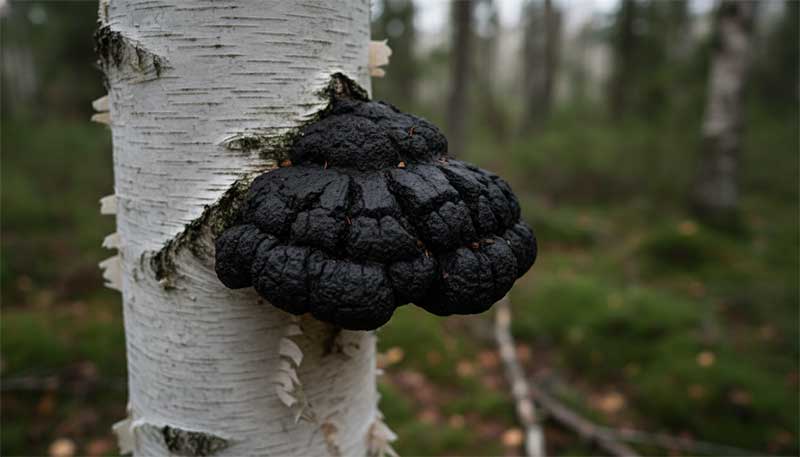
Chaga does not look like a mushroom. It looks like a burnt, cracked piece of charcoal growing out of a tree. In Siberia and parts of Scandinavia, that is exactly the point - traditional healers have used it for centuries precisely because it looks unlike anything else in the forest, and because it worked.
The Soviet pharmacopoeia took it seriously enough to officially list Chaga raw material for the treatment of gastritis, stomach ulcers and precancerous conditions back in the early 1960s. That is unusually formal validation for a forest fungus. The modern research picture is more nuanced than either the traditional reputation or the current "superfood" marketing suggests - and that nuance is worth understanding before you buy a tin of chaga powder.
What Is Chaga?
Inonotus obliquus is a parasitic fungus that grows almost exclusively on birch trees in cold northern climates - Siberia, Scandinavia, the northern United States and Canada. What you see and harvest is not the mushroom's fruiting body in the typical sense, but a sclerotium - a hardened mass of mycelium that the fungus produces as a survival structure. This is part of why Chaga behaves differently from Reishi or Lion's Mane: you are not consuming spore-producing tissue, you are consuming a dense, slow-grown defensive structure that the fungus took years to build.
That slow growth matters. Wild Chaga can take 15-20 years to mature on a single tree. This is also why cultivated Chaga mycelium products (grown quickly in a lab on grain substrate) are a fundamentally different product from wild-harvested birch Chaga - the compound concentrations are not comparable.
The Bioactive Compound Profile
The compound responsible for Chaga's black color, and one of its most distinctive features among medicinal mushrooms. Chaga melanin has shown significant antioxidant activity in extraction studies, with bioavailability varying considerably depending on extraction method.
Triterpenoids originally sourced from the birch bark the fungus grows on, then concentrated within the Chaga itself. Documented anti-inflammatory, liver-protective and anticancer properties in laboratory research. The most pharmacologically active compound class in Chaga.
A lanostane-type triterpenoid unique to Chaga. Shown to inhibit tyrosinase activity in cell studies (relevant to skin pigmentation research) and contributes to the proapoptotic activity studied in various cancer cell lines.
The immune-modulating fraction shared with most medicinal mushrooms. Chaga polysaccharides have documented antioxidant and immunomodulatory activity, and have shown applications in wound-related skin infections.
The ORAC Claim Problem
Almost every Chaga product makes some version of the claim: "highest antioxidant ORAC score of any natural food." This needs unpacking, because it is technically true and also mostly irrelevant.
ORAC (Oxygen Radical Absorbance Capacity) measures antioxidant activity in a test tube - literally how well a substance neutralizes free radicals in a controlled chemical reaction outside the human body. It does not measure what happens after digestion, absorption, and metabolism. The USDA itself removed the ORAC database in 2012, specifically because the values were being used to make health claims the data could not support.
A high ORAC score tells you a substance reacts strongly with free radicals in a lab dish. It does not tell you whether the active compounds survive digestion, get absorbed into your bloodstream, or do anything measurable inside your body. Chaga's antioxidant case rests on better ground than ORAC marketing suggests - betulinic acid and melanin have documented activity in cell and animal models - but the test tube number itself proves very little on its own.
What the Research Actually Shows
Liver Protection and Anti-Inflammatory Activity
Betulinic acid has documented hepatoprotective (liver-protective) properties across multiple studies, alongside its anti-inflammatory activity. This is one of the more consistently replicated findings in the Chaga literature and the most clinically interesting angle for general health use, separate from any cancer-related claims.
The Gut Microbiome Finding
This is the most interesting and least talked-about Chaga finding in recent years. A study examining melanin extracted from Chaga using different extraction methods found that microwave-extracted melanin fractions produced a bifidogenic effect - meaning they stimulated growth of Bifidobacterium bifidum, a beneficial gut bacterium, by roughly 40% compared to a vitamin C control within 24 hours. Different extraction methods produced melanin fractions with meaningfully different particle sizes, surface charges, and antioxidant capacity - which is itself an important finding: how Chaga is processed changes what it actually does in the body.
Cancer Cell Line Research: Real but Limited
Laboratory studies testing Chaga extracts against human cancer cell lines have found moderate cytotoxic activity - not high potency, but measurable effects across a wide range of tested cell lines, with the strongest inhibition observed in liver cancer cell lines. Chaga grown on different birch species (Betula pendula versus Betula pubescens) showed different potency, attributed to differing inotodiol content.
This is laboratory cell-line data, not clinical evidence. It tells you the underlying biology is worth continued investigation. It does not tell you Chaga treats or prevents cancer in a living human being, and no legitimate source should claim otherwise.
Antioxidant Mechanism
Well-documented in cell and animal models. Betulinic acid, melanin and polysaccharides all show independent antioxidant activity through different pathways.
Liver Protection
Consistently replicated hepatoprotective findings for betulinic acid specifically. Human clinical trial data for whole Chaga extract remains limited.
Immune Modulation
Polysaccharide fraction shows the same beta-glucan immune mechanism documented across medicinal mushrooms. Plausible but not as extensively trialed as Reishi's immune data.
Anticancer Activity
Real but preliminary - in vitro cell line studies only. Moderate, not high, cytotoxicity. Not a substitute for any cancer treatment or prevention strategy.
Quality: Why Source Matters More Than With Most Mushrooms
Chaga has more quality variation than almost any other medicinal mushroom on this site, for a structural reason: it is harvested wild from a single tree species, and its compound profile depends on the birch species, the age of the sclerotium, and the extraction method.
| Form | Effective Range | Notes |
|---|---|---|
| Wild-harvested chunks (Betula pendula) | For tea: 5-10g simmered 20+ min | Highest documented inotodiol content. Best for traditional preparation. |
| Dual extract (water + alcohol) powder | 1,000-2,000 mg/day | Captures both polysaccharides and triterpenoids. Best supplement form. |
| Cultivated mycelium-on-grain | Any dose | Avoid. Not grown on actual birch bark, missing the birch-derived betulinic acid pathway entirely. |
| Hot water extract only | 1,000-3,000 mg/day | Gets polysaccharides and melanin. Misses fat-soluble triterpenoids like betulinic acid. |
Look for "wild-harvested" and a specified birch species if possible. Avoid products that simply say "Chaga mycelium" without specifying fruiting body or sclerotium - this usually signals grain-grown mycelium with a fraction of the active compound content. Dual extraction (stated on the label) captures more of the full compound profile than water extraction alone.
Chaga contains oxalates at meaningfully high concentrations - a real concern for anyone with a history of kidney stones. It may also have mild blood-thinning and blood-sugar-lowering effects, which matters if you are on anticoagulant medication or diabetes medication. Anyone with an autoimmune condition should be cautious with immune-modulating mushrooms generally, Chaga included, and should discuss use with their doctor first.