Most supplement safety conversations focus on whether an ingredient works. That is the wrong starting point for a meaningful percentage of products on the market, because a real and growing body of testing data shows the more basic question is unanswered: is what's in the bottle actually what the label says it is, and is it free of things that were never supposed to be there at all?
This is not a fringe concern dressed up as alarmism. It comes from FDA laboratory testing, peer-reviewed contamination studies, and academic food fraud research - much of it published in the last two years. Three distinct problems get lumped together under the vague banner of "supplement safety," and they deserve to be separated, because each has a different mechanism, a different risk profile, and a different way to protect yourself.
Problem One: Heavy Metal Contamination
This is the most studied and most severe of the three problems, and it is concentrated heavily - though not exclusively - in traditional Ayurvedic medicine products.
A peer-reviewed analysis of 252 Ayurvedic medicine and herbal supplement samples found lead in 65% of samples, mercury in 38%, and arsenic in 32%. Nearly half of the samples containing mercury, and over a third of those containing lead or arsenic, had concentrations per pill exceeding the US Pharmacopeia's recommended daily intake limits - in some cases by up to several thousand times. A separate clinical review found that 20-65% of Ayurvedic medicines available online contain detectable lead, mercury, and/or arsenic at levels exceeding acceptable daily intake standards.
This is not historical data. In March 2025, the FDA announced a recall of several Zaarah Herbals products - Rasayan Churan, Gurmar Powder, Vasaka Powder, and Bhringraj Powder - after random testing found batches containing lead at up to 35 ppm and arsenic at up to 9 ppm, both far exceeding the FDA's permissible limits of 10 ppm and 3 ppm respectively. Separately, the FDA issued a direct warning after laboratory testing of a product called Rheumacare Ayurvedic Proprietary Medicine found high levels of lead and mercury, plus the presence of strychnine, brucine toxins, and arsenic - discovered after a consumer using the product developed extremely elevated blood lead levels.
Some heavy metal content in traditional Ayurvedic medicine is intentional, not contamination. Rasa Shastra, a branch of Ayurvedic pharmaceutics, deliberately incorporates metals and minerals - including mercury, lead, and arsenic - into formulations after a traditional "purification" process intended to make them safe for internal use. Modern toxicology testing frequently finds that this purification process does not reliably remove the toxic risk. This means the presence of these metals is sometimes by design, not negligence, which makes consumer awareness even more important since the product is not malfunctioning - it is working as traditionally formulated, and that formulation predates modern toxicology.
A documented clinical case illustrates the real-world stakes: a woman using Ayurvedic supplements prescribed by a holistic healer for years developed small fiber polyneuropathy with measurable nerve damage, later traced to elevated blood lead (26.4 mcg/dL against a normal threshold under 10) and significantly elevated arsenic levels, confirmed through urine testing and referred to medical toxicology.
Problem Two: Deliberate Adulteration and Food Fraud
This is a different mechanism entirely - not accidental contamination from traditional processing, but deliberate economic fraud, where cheaper or harmful substances are substituted or added to make a product appear more authentic, more potent, or more visually appealing.
Saffron: The World's Most Faked Spice
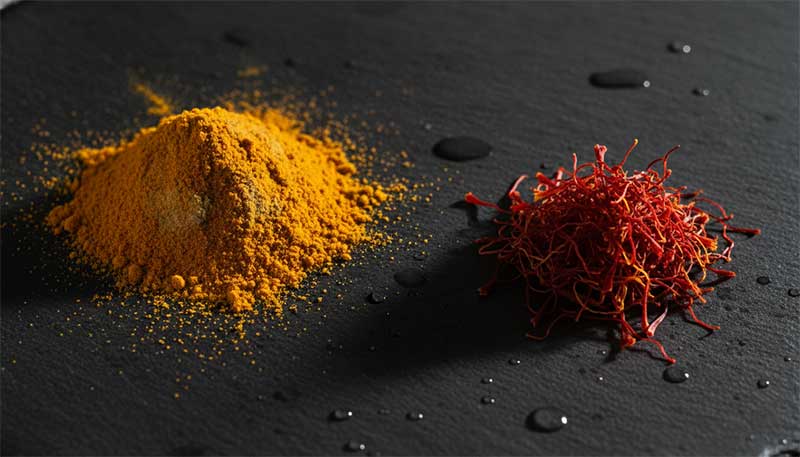
A systematic review synthesizing 23 studies on saffron authenticity found that 20-30% of commercial saffron globally is adulterated, with dramatic regional variation - as low as 3.5% in tightly regulated EU markets, but up to 60% in some Indian market samples. Common fraud methods include substitution with safflower, marigold, or turmeric, dilution with other plant material, and the addition of hazardous synthetic dyes including Sudan compounds and auramine-O - dyes that are not food-safe and have documented carcinogenic potential.
Turmeric: Lead Chromate Chosen for Its Color Match
This is one of the more disturbing examples of deliberate adulteration because the substitute was specifically chosen for visual deception. Lead chromate is a toxic industrial pigment that happens to closely match turmeric's natural yellow-orange color - which is precisely why it has been documented as a turmeric adulterant across multiple countries, most extensively studied in Bangladesh, where researchers connected lead chromate-adulterated turmeric directly to elevated blood lead levels in the population, prompting the Bangladesh Food Safety Authority to declare the practice a prosecutable offense and train inspectors to use handheld X-ray fluorescence devices to detect it in markets.
A 2025 scoping review pooling data across six continents and nearly 1,000 product samples found turmeric adulteration rates varying significantly by region - estimated at roughly 15-17% in Asia and around 15-22% in North America, depending on which underlying studies are included - with adulterants including artificial dyes (lead chromate, metanil yellow), undeclared diluents, and undisclosed synthetic curcumin added to make extracts appear more potent than they actually are.
For saffron specifically, a widely cited visual test exists: place a few strands in cold water. Genuine saffron releases its golden color gradually over several seconds while the strands remain largely intact. Fraudulent saffron - dyed corn silk, safflower, or paper strips - tends to release color very quickly or fall apart entirely. This will not catch every type of fraud, but it is a free, immediate first check available to anyone.
Problem Three: Hidden Pharmaceutical Drugs
This is arguably the most acutely dangerous category, because it involves products that contain undisclosed prescription-strength pharmaceutical compounds - not trace contamination, but deliberately added active drugs at potentially significant doses, sold to consumers who have no idea they are taking them.
An academic analysis of FDA warnings about tainted dietary supplements found that body-building and muscle-building products were most frequently adulterated with anabolic steroids or steroid-like substances, associated with documented risks including acute liver injury, stroke, heart attack, and pulmonary embolism. Some muscle-building products were found to contain aromatase inhibitors - compounds that interfere with normal hormone conversion and are associated with infertility, kidney failure, and liver dysfunction. Sexual enhancement products were frequently found to contain undisclosed analogs of the active ingredients in prescription erectile dysfunction medications, which carry real cardiovascular risk for people with underlying heart conditions who have no idea they are taking a drug-strength dose. Products marketed for other purposes were most commonly adulterated with diclofenac (a prescription anti-inflammatory) or dexamethasone (a corticosteroid) - neither disclosed on the label.
Muscle-Building Products
Most frequently adulterated category in FDA warning data. Anabolic steroids and aromatase inhibitors found undisclosed, linked to liver injury, cardiovascular events, and kidney damage.
Sexual Enhancement Products
Frequently contain undisclosed analogs of prescription ED medication active ingredients, posing real cardiovascular risk to users with heart conditions who are unaware they are taking a drug.
Weight-Loss Products
Historically a major category for hidden pharmaceutical adulteration, including banned stimulants and unapproved drug compounds not listed on labels.
General Health Products
Most commonly adulterated with diclofenac or dexamethasone when marketed for indications outside the three categories above - still undisclosed, still a real risk.
The Scale of the Problem in Numbers
One study estimated that dietary supplement use is associated with roughly 23,000 emergency department visits and 2,000 hospitalizations annually in the United States. Separately, liver specialists estimate the broader category of medication- and supplement-related liver damage at approximately 44,000 cases per year in the US, including around 2,700 deaths - and the underlying incidence is likely higher than reported, since liver failure symptoms are often vague and people taking "natural" supplements may not connect their symptoms to what they are taking, or may be reluctant to mention supplement use to a doctor at all.
This matters structurally because of how US regulation actually works. The Dietary Supplement Health and Education Act of 1994 limits the FDA's authority over supplements to a post-market role - the agency cannot require pre-market safety testing or proof of label accuracy before a product reaches store shelves. Enforcement happens only after a product is already in consumers' hands and has been flagged as adulterated or misbranded, typically following an adverse event report or independent testing.
What Actually Protects You
| Risk Factor | What to Check | Why It Matters |
|---|---|---|
| Traditional Ayurvedic/herbal formulas with multiple unnamed ingredients | Third-party heavy metal testing (CoA available) | Highest documented contamination rate of any supplement category reviewed here. |
| High-value spices: saffron, turmeric, cinnamon | Color/aroma consistency, lab-verified sourcing, price too good to be true | Economically motivated adulteration concentrates in expensive, hard-to-verify botanicals. |
| Muscle-building, sexual enhancement, rapid weight-loss products | FDA Health Fraud Product Database, avoid "alternative to prescription drug" marketing language | Highest documented rate of hidden pharmaceutical drug content of any category. |
| Any product without a Certificate of Analysis | Request batch-level third-party lab results before buying | The single most reliable signal that a manufacturer is actually testing for what matters. |
Poison control centers received over 1,000 more reports of supplement-related adverse events than the FDA did over a recent three-year period - meaning a meaningful share of harm never reaches the agency that could act on it. Routinely disclosing supplement use to your doctor, especially before surgery, when starting new medications, or if you experience unexplained fatigue, jaundice, or neurological symptoms, is one of the few protective steps that costs nothing and has no downside.