Silicon is a genuinely interesting case among the minerals covered on this site, because the underlying biology is real and well-established, while the specific commercial evidence built on top of it is unusually concentrated in one ingredient and one small circle of researchers. This article tries to keep those two things separate: what silicon does in the body, broadly, versus what a specific branded supplement has actually been shown to do in a specific, narrow set of trials.
Is Silicon Actually Essential? The Animal Evidence Is Solid
The case for silicon as a genuinely important nutrient doesn't start with a supplement company - it starts with a 1972 study published in the journal Science, in which researcher Edward Carlisle demonstrated that chicks raised on a silicon-deficient diet developed abnormal, poorly mineralized bone and defective connective tissue, and that adding silicon back to the diet corrected the problem. Follow-up work through the 1970s and 1980s, much of it also from Carlisle's lab, showed that silicon plays a role in collagen synthesis and the activity of prolyl hydroxylase, an enzyme central to building the collagen matrix that gives bone and connective tissue their structure. This is genuine, foundational, independently-cited biology, not a marketing invention.
Where the picture gets less clear-cut is in humans specifically. There's no established Recommended Dietary Allowance for silicon, and no confirmed human deficiency syndrome has ever been clinically described the way, say, iron or vitamin C deficiency has - partly because silicon is so ubiquitous in ordinary diets (cereals, grains, and many vegetables all contain meaningful amounts) that a deficient diet is difficult to construct in practice. What does exist is a genuinely useful human observational signal: dietary silicon intake, estimated from food-frequency questionnaires in both the original Framingham Study and the Framingham Offspring Study, was positively associated with bone mineral density in men and premenopausal women - a real, independently conducted, population-level finding that doesn't depend on any particular supplement brand.
Where the Human Supplement Evidence Actually Comes From
This is the part of silicon's story that deserves the most careful, direct treatment, because it shapes how much weight every other claim in this article can reasonably bear. Nearly every human clinical trial testing silicon for hair, skin, or bone outcomes uses one specific, patented form: choline-stabilized orthosilicic acid, marketed under the trade name ch-OSA and sold commercially as BioSil. It is not simply "silicon" in the generic sense - it's a proprietary stabilized complex, and the research base behind it is correspondingly narrow.
The human ch-OSA trials cited throughout the supplement industry were conducted by a small, recurring group of researchers (Calomme, Vanden Berghe, and colleagues, largely based in Belgium), and at least two authors involved in this broader line of silicon supplement research have explicitly disclosed consulting relationships with BioMinerals NV, the company that manufactures ch-OSA, in a published response to a scientific letter. This doesn't mean the trials were fabricated or the results are false - they were published in peer-reviewed journals and used standard randomized, double-blind, placebo-controlled designs. But it does mean the evidence base is unusually concentrated: a genuinely independent research group, unconnected to the ingredient's manufacturer, has not stepped in to replicate these specific findings, which is a real gap for a supplement category with such prominent, oft-repeated marketing claims.
Hair and Skin: Small, Positive, Industry-Adjacent Trials
With that context in place, the actual findings are worth walking through, because they are genuinely positive within their own limits - the question is how much weight they can bear.
Hair Tensile Strength
Women with self-reported fine hair took 10mg/day of silicon as ch-OSA or placebo. The ch-OSA group showed significantly better preservation of hair elasticity and break load, along with increased hair thickness, compared to the placebo group, based on direct physical tensile testing of hair samples.
Skin Surface and Mechanical Properties
Women with photodamaged facial skin took 10mg/day of ch-OSA or placebo. Skin roughness measurements improved in the ch-OSA group while worsening in the placebo group over the same period, and self-reported nail and hair brittleness scores also improved significantly.
Both trials were randomized, double-blind, and placebo-controlled, which is a meaningfully better design than most supplement studies on this site can claim. The improvements were also measured with objective, non-subjective tools - tensile testing equipment for hair, surface-relief imaging and mechanical anisotropy measurement for skin - rather than relying purely on participant self-report. These are real strengths. The limitation isn't the design of either individual trial; it's that both come from the same small research circle, using the same proprietary ingredient, and neither has been independently repeated by a research group with no connection to the manufacturer.
Bone Density: A Weaker Result Than the Marketing Implies
This is the claim most heavily featured in silicon supplement marketing, tracing directly back to the animal essentiality research described above - and it's also the claim where the human trial data turns out to be considerably weaker than the surrounding promotional language usually suggests.
WomenOsteopenic, 12 Months
SeveralBone Markers Reached Significance
This same 12-month bone trial recorded one serious adverse event: a case of cerebellar thrombosis in a participant in the ch-OSA group, which the study's ethics committee formally classified as reportable. To be clear about what this does and doesn't mean - a single adverse event in a small trial arm is generally too little information to establish or rule out causation, and thrombosis has many common causes unrelated to any supplement. It's mentioned here because thorough safety reporting means disclosing this kind of detail rather than omitting it, not because it should be read as proof of a specific silicon-related risk.
The Real Standout Finding: Diet, Not Supplements
Ironically, the most solid, independently replicated silicon research doesn't involve any branded supplement at all - it comes from dietary intake studies conducted by a completely separate research group (Jugdaohsingh, Powell, and colleagues, based in the UK), unconnected to the ch-OSA/BioMinerals line of research.
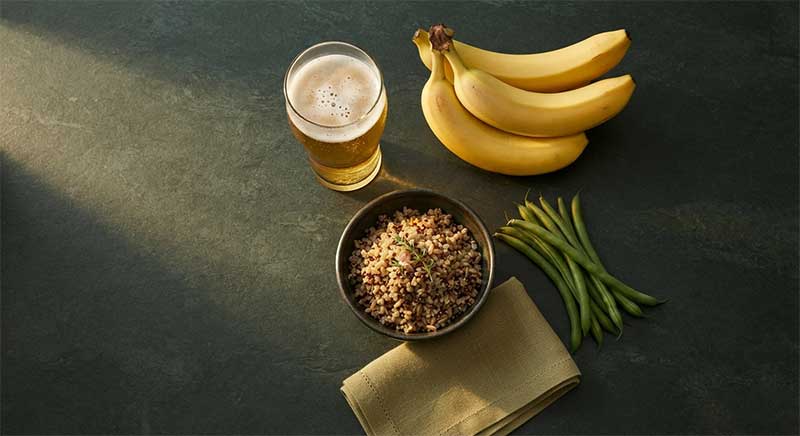
Analysis of the Framingham Study and Framingham Offspring Study cohorts found that beer and bananas were the major food sources of silicon for men, while bananas and string beans were the major sources for women - with beer alone containing roughly 1-6mg of silicon per 100ml, largely because the malting and mashing process extracts soluble orthosilicic acid from barley's natural silica content. Whole grains (up to 425mg per 100g in some cereals), green beans (up to 44mg per 100g raw), and raisins also rank among the richest ordinary dietary sources. This is a genuinely independent finding, replicated across multiple cohort analyses by a research group with no connection to any silicon supplement manufacturer, and it's the dietary intake data - not a branded ingredient - that correlates with bone mineral density in the population studies described earlier in this article.
A Practical Approach
Using Silicon Sensibly
Dosing
| Purpose | Typical Studied Dose | Notes |
|---|---|---|
| Hair strength / thickness (ch-OSA) | 10mg Si/day, 9 months | From a single small trial (48 women); no independent replication found |
| Skin texture (ch-OSA) | 10mg Si/day, 20 weeks | From a single small trial (50 women); no independent replication found |
| Bone (ch-OSA, adjunct to Ca/Vit D3) | 6mg Si/day showed the clearest (limited) signal | No clear dose-response across 3, 6, and 12mg doses tested; effect on actual BMD was non-significant |
| General dietary intake | ~20-33mg/day is typical Western intake | From whole grains, green beans, bananas, and beer; associated with bone density in cohort studies |
Silicon in the forms studied (ch-OSA, dietary orthosilicic acid) has an excellent overall safety record with no established toxicity at typical supplemental or dietary doses, and regulatory safety opinions exist for several specific silicon supplement sources in the EU. A single serious adverse event (cerebellar thrombosis) was recorded in one bone trial's ch-OSA arm; this is not established as causally related given the small sample size, but is worth being aware of. As with any supplement, disclose use to your physician, particularly if you have a personal or family history of clotting disorders, though no established mechanism currently links silicon supplementation to clotting risk.
What It Stacks Well With
Whole Grains & Beer (Moderate Intake)
The most consistently documented dietary sources of bioavailable silicon in Western diets.
Calcium & Vitamin D3
Studied specifically as a combination in the flagship bone trial - silicon alone was not tested against bone density.
Bananas & Green Beans
Additional well-documented dietary silicon sources identified in Framingham cohort analysis.
Standard Bone Density Screening
Keep this as your primary monitoring tool rather than relying on a silicon supplement's marketing claims.
Independent Product Verification
Given the concentrated research base, third-party testing matters more than usual for confirming what's actually in a product.
Clotting Disorder History (Disclose to Physician)
Precautionary, given one disclosed adverse event in trial data - no established causal mechanism currently exists.