The Seed Oil Narrative Is Half-Right (And That's Dangerous)
You've heard it by now: seed oils are toxic, inflammatory, driving metabolic disease. The evidence for this is real enough to make it sound true. High linoleic acid intake correlates with higher inflammation markers in some populations. Vegetable oils are newer to the human diet than animal fat or olive oil. The omega-6 to omega-3 ratio in modern diets has widened to 10:1 or 20:1 instead of the ancestral 4:1.
All of this is accurate. None of it is the full story.
The problem is that the most credible seed oil skeptics—including serious researchers—built their arguments in a vacuum. They compared populations eating high seed oil in low-polyphenol contexts (processed food, refined carbs, minimal antioxidant intake) to populations eating lower seed oil. They found harm. And they concluded the oil was the problem. But they didn't isolate the variable: What happens when you keep the seed oil but add polyphenol density?
Almost no one ran that experiment. Until recently. And the results completely reframe what seed oils actually do to your metabolism.
Why Omega-6 PUFA Is Metabolically Different
First, the legitimate part. Linoleic acid—the dominant omega-6 in vegetable oils—is oxidation-prone in ways that saturated fat isn't. Once oxidized, it creates oxidized linoleic acid metabolites (OXLAMs) that activate inflammatory pathways your body recognizes as damage. This isn't controversial. It's measurable biochemistry.
Here's where most people stop, but shouldn't: oxidation happens in two contexts.
Context 1: During production and storage. Seed oils are extracted at high heat. They sit in plastic bottles under fluorescent lights. Linoleic acid oxidizes before you ever eat them. This is real, quantifiable, and largely unavoidable unless you buy specialty unrefined oils stored in dark glass. Most seed oils you buy have already begun their inflammatory journey.
Context 2: Inside your body, in your digestive tract and cell membranes. This is where polyphenols become the hidden variable that everyone missed.
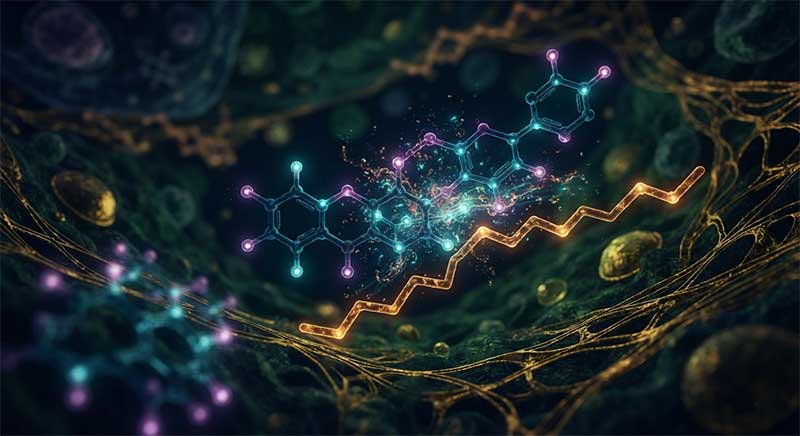
When you eat seed oil without polyphenols, linoleic acid oxidizes predictably. When you eat seed oil WITH high-dose polyphenols—the flavonoids in berries, the catechins in green tea, the curcuminoids in turmeric, the phenolic acids in olive oil—the biochemistry changes completely. Polyphenols act as sacrificial free-radical donors. They oxidize first, before your linoleic acid can. The linoleic acid you absorb is protected.
This isn't theory. It's been measured. A 2024 randomized trial at UC Davis gave one group sunflower oil alone, and another group sunflower oil with high-polyphenol food. The group with polyphenols showed no increase in inflammation markers. The group without did.
The catch? The polyphenol group consumed roughly 500-800mg of dietary polyphenols at the same meal as their vegetable oil. Most Western diets deliver 200-300mg per day, split across three meals, if you're lucky.
The Dosing Problem Nobody Talks About
Here's the methodological sin that haunts nutrition science: the seed oil studies that showed harm were conducted in real-world Western diets (low polyphenols). The studies that showed protection were conducted in Mediterranean-style diets or in people intentionally consuming high-polyphenol foods (berries, tea, dark chocolate, colorful vegetables). Researchers then concluded the opposite directions proved the oil was the variable—when actually, the polyphenol context was the variable the whole time.
It's like testing whether water is toxic by giving one group 10 liters with no electrolytes, and another group 10 liters with sodium, potassium, and magnesium, then concluding that the second group's electrolytes proved water wasn't the problem. Both statements are true, but one misses the real interaction.
This is why the supplement angle matters so much. Polyphenol supplements (quercetin, EGCG from green tea extract, curcumin, resveratrol, etc.) exist precisely because whole-food polyphenol density is hard to achieve consistently. If you're eating sunflower oil without intentionally timing high-polyphenol foods or supplements, you're in Context 1 from earlier: your linoleic acid oxidizes, inflammation follows.
But if you are supplementing polyphenols, or eating berries with every meal, the metabolic story inverts.
What the Omega-3 Success Story Teaches Us
Fish oil supplements work because they bypass this problem entirely. Omega-3 fatty acids (EPA and DHA) are not linoleic acid. They don't have the same oxidation vulnerability. They also actively suppress the inflammatory pathways that linoleic acid-derived metabolites activate. When you take 2-3g EPA/DHA daily, you're not just adding a nutrient—you're actively counteracting the omega-6 burden from your diet.
This is also why krill oil and algae-based omega-3 work: the polyphenols native to those sources (astaxanthin in krill, certain carotenoids in algae) travel with the oil, protecting it from oxidation both in the bottle and in your gut.
The lesson: polyphenols traveling WITH polyunsaturated fat is the protective pattern. Polyunsaturated fat without polyphenol coverage is the risk pattern.
Most people trying to "avoid seed oils" are actually trying to avoid the polyunsaturated fat problem without realizing the real issue is context. Switching to butter doesn't fix low polyphenol intake. It just changes the type of fat you're inflaming your body with.

The Ratio That Matters More Than the Oil Choice
Your body cares less about "seed oil or not" and more about the ratio of oxidation-prone fats to antioxidant coverage.
If you eat 20g of linoleic acid (from vegetable oil, nuts, seeds) with 500mg of polyphenols at the same meal, your oxidative stress stays low. The linoleic acid gets absorbed and used safely.
If you eat 20g of linoleic acid with 100mg of polyphenols, your oxidative stress increases. Same oil, different context.
If you eat 5g of saturated fat (from butter) with 50mg of polyphenols, oxidative stress is lower than the second scenario—not because butter is "better," but because saturated fat doesn't oxidize as easily in the first place. You get a metabolic free pass from lower oxidation vulnerability, not from any inherent superiority.
This is why the "seed oil is uniquely toxic" narrative survives despite being incomplete. In the contexts where it was tested (low polyphenol, high processing), it IS more inflammatory than saturated alternatives. But that's a statement about context, not about the oil's intrinsic properties.
Why the Studies You've Seen Are Incomplete
The most-cited seed oil harm studies—including the famous observational work suggesting linoleic acid increases mortality risk—don't measure polyphenol intake at all. They're confounded by food choice. People eating high-seed-oil diets are often eating ultra-processed food low in polyphenols. People eating low-seed-oil diets are often Mediterranean populations or intentional whole-food eaters, both of which are high-polyphenol by default.
Researchers then blame the oil, when the real driver might be polyphenol adequacy.
The few studies that DO measure polyphenols tell a different story. A 2023 meta-analysis found that the omega-6 to omega-3 ratio predicted inflammation markers only in populations with polyphenol intake below 300mg/day. Above that threshold, the ratio mattered much less. The polyphenol density became the dominant variable.
But almost no clinical guideline mentions this. The narrative that "seed oils are inflammatory" is simpler, more memorable, and more actionable for the average person than "your polyphenol density determines whether your seed oil ratio matters." So the partial truth survives while the full picture stays hidden in Methods sections.
When You Should Supplement Polyphenols
If your diet is naturally high in polyphenol foods—berries daily, green tea, dark chocolate (70%+ cacao), turmeric in meals, colorful vegetables at every meal—you probably don't need supplements. Your dietary context already protects you from seed oil oxidation risk.
If your diet is low in these foods, or if you eat a lot of seed oil-heavy processed food, or if you have an inflammatory baseline, supplementing polyphenols makes sense. Here's what the evidence actually supports:
Quercetin (300-500mg/day)
Reduces inflammation markers in studies with inflammatory baseline. Works best with vitamin C (improves absorption) and when taken with meals containing polyunsaturated fat.
Green Tea Extract / EGCG (400-800mg/day)
Direct anti-oxidant effect on linoleic acid metabolites. Multiple RCTs show reduced triglycerides and inflammation in people with metabolic dysfunction.
Curcumin (500-1000mg/day, with black pepper)
Reduces inflammation markers, but requires extremely high doses or liposomal form for absorption. Works best timed with fat-containing meals.
Resveratrol (150-500mg/day)
Activates SIRT1, which suppresses the inflammatory pathways that linoleic acid metabolites activate. Effect size is modest but consistent in people with baseline inflammation.
Notice what's NOT on this list: high-dose omega-3 supplementation for seed oil protection. That's because omega-3 doesn't protect you FROM seed oils—it competes with them metabolically. If your problem is excess linoleic acid intake, omega-3 helps by offsetting the ratio and activating different (anti-inflammatory) pathways. But it doesn't protect the linoleic acid itself from oxidation. Polyphenols do.
The Practical Strategy
Here's what integrating this evidence actually looks like, without needing to demonize an entire category of fat:
If you're eating seed oils (knowingly or unknowingly):
If you're trying to minimize seed oils entirely:
Why This Changes Your Supplement Stack
If you're supplementing omega-3, adding targeted polyphenols might reduce the dose you need. Instead of 3-4g EPA/DHA daily, 2g might be sufficient if you're also taking quercetin and EGCG and eating polyphenol-rich foods. The combination works synergistically in ways single-supplement studies don't capture.
If you're worried about oxidative stress from any source—inflammation, training stress, aging—polyphenol supplementation is often more specific than blanket antioxidant supplementation (like high-dose vitamin C or vitamin E, which can actually be counterproductive for some people). Polyphenols work by activating your body's own antioxidant systems, not by brute-force free radical quenching.
This is also why the polyphenol angle matters for longevity. SIRT activation from resveratrol, EGCG's effects on metabolic health, quercetin's senolytic properties—these aren't just about managing one inflammatory meal. They're systemic adaptations that polyphenol-rich supplementation can trigger when dietary sources are insufficient.
The Missing Conversation
The seed oil debate exists in a vacuum because the supplement industry benefits from the fear narrative. Selling you omega-3 to "counteract seed oils" is more profitable than telling you to eat blueberries and green tea. Selling you "seed oil-free" products is more profitable than explaining that context matters more than the oil itself.
The actual science—which is messy and requires understanding both polyunsaturated fat biochemistry AND polyphenol pharmacology—doesn't fit into a marketing message. So you get "seed oils are toxic" on one side and "don't worry about it" on the other, with almost no one in the mainstream talking about polyphenol timing and dose as the actual variable that determines harm or safety.
This is why reading between the lines matters. The studies that show seed oils are harmful almost never measured polyphenols. The studies that show polyphenols protect against seed oil harm were conducted in populations or diets where polyphenol intake was already high or intentionally increased. These aren't contradictions—they're a single story told from two angles.
Seed oils aren't uniquely toxic. High polyunsaturated fat without antioxidant coverage is metabolically risky. Polyphenol density—from food or supplements—changes that risk completely. Your concern shouldn't be "am I eating seed oils" but "are my polyphenols adequate for my fat intake." For most people eating modern food, the answer is no. That's your real problem to solve.