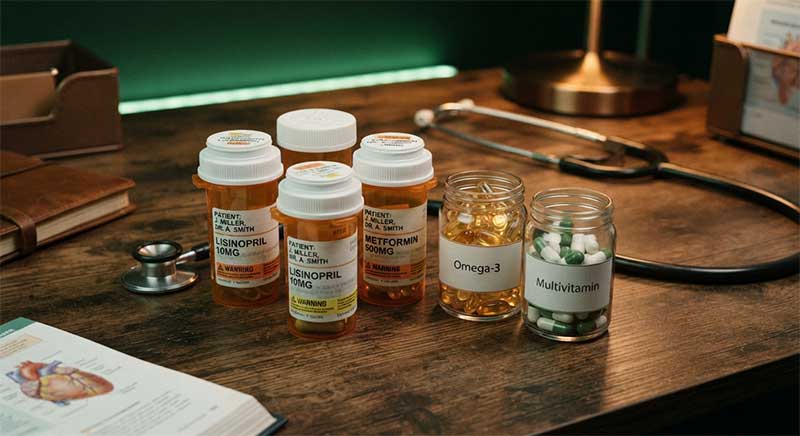
The Silence in Your Doctor's Office
Your doctor asks about alcohol. They ask about other drugs. They ask about allergies. They almost never ask about supplements.
This isn't because they think supplements don't matter. It's because the medical system has no infrastructure to track them. There's no FDA-mandated adverse event reporting for supplements the way there is for drugs. There's no computerized interaction checker that flags "patient is on simvastatin and just started CoQ10" the way it flags drug-drug conflicts. There's no professional liability protection if a supplement causes harm and the doctor didn't screen for it, but also no legal requirement that they do.
So most doctors don't ask. And most patients don't volunteer the information, assuming supplements are too minor to matter.
The gap between these two silences is where real harm happens.
A patient on a statin starts taking CoQ10 to reduce muscle pain—a reasonable move based on legitimate evidence. But CoQ10 is a lipophilic molecule that accumulates in cell membranes and can slightly reduce cholesterol synthesis. In some patients, it blunts the statin's effect enough to meaningfully change their LDL trajectory. The doctor sees the lipid panel get worse, increases the statin dose, and attributes it to disease progression. The patient never mentions the CoQ10. Six months later, the LDL is controlled again—but now the patient is on a higher statin dose with higher side-effect risk, and nobody knows why.
That's not an edge case. That's the standard failure mode of a system that doesn't ask and doesn't track.
Why This Database Doesn't Exist
The FDA regulates drugs through a mechanism called adverse event reporting. If a medication causes harm, it goes into a database. Researchers can search for patterns. Regulators can issue warnings. It's imperfect, but it exists and it works at scale.
Supplements have no equivalent system. The Dietary Supplement Health and Education Act (DSHEA) of 1994 classified supplements as food, not drugs. This means manufacturers don't need FDA approval before selling them. They also don't need to report adverse events unless directly challenged by the FDA. The FDA can pull a supplement off the market only if they can prove it's unsafe—the reverse of the drug approval process, where you prove safety first.
In practice, this means the adverse event database for supplements is incomplete by design. It catches the obvious cases: someone takes a supplement and has a heart attack or stroke, and it gets reported. But the subtle interactions—where a supplement changes how a drug works, or accumulates risk over months—mostly disappear into silence.

Even worse, many supplement-drug interactions aren't tested because there's no profit motive. Pharmaceutical companies test drug-drug interactions because they're selling the drugs. Supplement companies have no obligation to test how their product interacts with the medications millions of people are actually taking. The science that exists is usually academic curiosity or accident—a researcher noticed a pattern and decided to investigate.
So we have a situation where doctors have no way to ask, patients have no way to know, regulators have no systematic way to track, and researchers have no funding to systematically explore. The database that should exist, doesn't.
Three Interactions You Need to Know About
Case 1: Statins + CoQ10 (The Lipid Paradox)
Statin-Induced CoQ10 Depletion vs. CoQ10 Supplementation
Statins inhibit HMG-CoA reductase, which blocks cholesterol synthesis. This same enzyme is upstream of CoQ10 synthesis. Statins deplete cellular CoQ10 by roughly 20-30%, which can contribute to statin-related muscle pain in some patients.
The logical move: take CoQ10 to replace what the statin depleted. The problem: CoQ10 is a lipophilic antioxidant that accumulates in cell membranes and reduces oxidative stress. In the hepatocyte, reduced oxidative stress can decrease the expression of genes involved in cholesterol synthesis and LDL receptor trafficking. In some patients, this blunts the statin's cholesterol-lowering effect.
This isn't theoretical. A 2010 RCT in Japan showed patients taking simvastatin + CoQ10 (200mg/day) had 18% higher LDL than patients on simvastatin alone—after 12 weeks. The effect disappeared after CoQ10 was stopped, confirming causation.
The tragedy: patients supplementing CoQ10 for the right reason (statin myopathy) can end up with worse cardiovascular outcomes because their LDL control suffered. And nobody caught it because the interaction wasn't flagged in the clinic.
What to do: If you're on a statin and have muscle pain, don't automatically add CoQ10. First, get your LDL checked after starting the supplement. If it rises by more than 10-15%, CoQ10 is likely interfering. Consider lower doses (50-100mg) or alternative muscle-pain strategies (ubiquinol form, L-carnitine, creatine). Always recheck lipids 4-6 weeks after any supplement change.
Case 2: Warfarin/DOACs + High-Dose Omega-3 (The Bleeding Risk)
Anticoagulant + Antiplatelet Supplement
Warfarin works by inhibiting vitamin K-dependent clotting factors. Omega-3 fatty acids (especially EPA and DHA) have mild antiplatelet effects—they reduce platelet aggregation and slightly increase bleeding time. The effect is small with dietary omega-3. But at supplemental doses (2-4g EPA/DHA daily), the antiplatelet effect becomes measurable.
When you add high-dose omega-3 to warfarin, you're stacking two anticoagulant mechanisms. The result: increased bleeding risk and increased INR variability.
The evidence: Multiple observational studies show omega-3 supplementation correlates with increased bleeding events in anticoagulated patients. A 2012 study found patients on warfarin + high-dose omega-3 had INR values 1.5-2.0 points higher than warfarin alone, even when warfarin dose was held constant.
The DNOACs (apixaban, rivaroxaban) are slightly safer because they're less sensitive to individual dietary variations—but high-dose omega-3 still increases bleeding risk, just less unpredictably.
What to do: If you're on any anticoagulant and want to supplement omega-3, stick to doses under 1g combined EPA/DHA daily, or better yet, skip the supplement and get omega-3 from food (fatty fish 2-3x/week). If you're already on a high-dose omega-3 supplement and starting anticoagulation, tell your anticoagulation clinic. They may need to start you at a lower dose and titrate more conservatively. Never combine high-dose omega-3 with NSAIDs if you're anticoagulated.
Case 3: SSRIs + 5-HTP (The Serotonin Syndrome Risk)
Serotonin Reuptake Inhibitor + Serotonin Precursor
SSRIs (sertraline, paroxetine, fluoxetine) work by blocking serotonin reuptake, keeping serotonin in the synapse longer. 5-HTP is a supplement that directly increases serotonin synthesis—it's the immediate precursor to serotonin in your neurons.
The combination means you're both keeping serotonin around longer (SSRI) and making more serotonin (5-HTP). In rare cases, this causes serotonin syndrome: a condition where excessive central serotonergic activity causes agitation, confusion, rapid heart rate, high blood pressure, muscle rigidity, and potentially fatal hyperthermia.
Serotonin syndrome is rare—most people on SSRIs + 5-HTP don't get it. But the risk exists and increases with higher doses of both. It's most dangerous in people already on MAOIs (where the interaction is more severe) or with certain genetic polymorphisms that slow serotonin metabolism.
The evidence: Dozens of case reports in medical literature. No large RCT because you can't ethically randomize people to a potentially dangerous combination. But the pattern is consistent enough that most psychiatrists treat SSRI + 5-HTP as contraindicated.
What to do: If you're on an SSRI and having mood or sleep issues, don't add 5-HTP without talking to your psychiatrist. There are safer alternatives: magnesium glycinate for sleep, L-theanine for anxiety, or adjusting the SSRI dose. If you're already on 5-HTP and starting an SSRI, tell your psychiatrist so they can monitor you. Never combine either with an MAOI. If you develop agitation, rapid heart rate, or muscle rigidity after adding 5-HTP to an SSRI, stop both and go to the ER.
Why Your Doctor Probably Doesn't Know This
Medical school doesn't teach supplement interactions. Residency programs don't have modules on it. Continuing medical education for physicians rarely covers it because there's no major pharmaceutical company paying to educate doctors about supplements that compete with their drugs.
Pharmacists, by contrast, are trained extensively on interactions—including supplement-drug interactions. But most patients talk to their doctor, not their pharmacist, before starting something new. And most pharmacists don't proactively reach out to patients on medications to ask about supplements.
The few doctors who do stay informed about supplement interactions usually learned it through:
- Personal patient harm (they had a patient get hurt and dug into it)
- Specialty training (naturopathic doctors, integrative medicine practitioners)
- Research interest (academic physicians investigating a specific interaction)
- Accident (stumbling into the literature)
For most physicians, supplements are outside their wheelhouse. It's not neglect—it's a knowledge gap baked into the medical training system.
The Accumulation Problem
Most attention to drug-supplement interactions focuses on individual pairs: statin + CoQ10, warfarin + omega-3, SSRI + 5-HTP. But the real danger in modern medicine isn't individual interactions—it's accumulation.
A typical patient with metabolic dysfunction might be on:
- Metformin (diabetes)
- A statin (cardiovascular risk)
- An SSRI (depression/anxiety)
- An antihypertensive (blood pressure)
And might be taking:
- Omega-3 (cardiovascular health)
- CoQ10 (energy, statin myopathy)
- Magnesium (sleep, muscle pain)
- 5-HTP (mood)
- Vitamin D (immune function)
- A probiotic (gut health)
Some of these have direct interactions (statin + CoQ10, SSRI + 5-HTP). Some have indirect interactions through shared metabolic pathways (omega-3 + other anticoagulants + NSAIDs). Some have additive effects without being true interactions (magnesium + metformin both affect mineral absorption, reducing the effectiveness of both).
No doctor has checked this comprehensively. No database can. The patient is essentially running an uncontrolled experiment on their own metabolism.

What You Actually Need to Do
Your Personal Interaction Audit
The Supplements Most Likely to Cause Problems
High-Dose Omega-3 (>2g EPA/DHA)
Antiplatelet effect increases bleeding risk with anticoagulants, NSAIDs, antiplatelet drugs. Can also interfere with statin efficacy in some patients.
St. John's Wort
Induces CYP3A4, the enzyme that metabolizes dozens of drugs. Reduces efficacy of SSRIs, birth control, immunosuppressants, anticoagulants, statins, and more.
High-Dose Garlic or Ginger
Both have mild antiplatelet effects. Combined with anticoagulants or NSAIDs, increase bleeding risk. Ginger also inhibits CYP3A4 slightly, affecting drug metabolism.
Vitamin K (Especially K2)
Directly antagonizes warfarin. If you're on warfarin, consistency matters more than avoidance—stable low-dose K2 is fine, but suddenly adding it will increase INR variability.
CoQ10 (100mg+)
Can interfere with statin efficacy in some patients. Also mild antiplatelet effect, adds to bleeding risk with anticoagulants or NSAIDs.
5-HTP
Increases serotonin directly. Risk of serotonin syndrome with SSRIs, especially at high doses. Contraindicated with MAOIs.
Notice what's NOT on this list: magnesium, vitamin D, probiotics, zinc, most B vitamins. These have lower interaction risk and are generally safe to combine with most medications (though some nuances exist—ask your pharmacist).
What Needs to Change
Ideally, the solution would be systemic. The FDA would require adverse event reporting for supplements the way they do for drugs. Health systems would integrate supplement screening into electronic medical records. Doctors would get training on interactions. Pharmacists would proactively reach out to patients on medications about supplements.
None of this is happening, and it won't happen soon. The regulatory incentives don't exist. The business model doesn't reward it. The liability is murky enough that most health systems avoid it.
Until that changes, you're responsible. Not because it's fair—it's not. But because the alternative is trusting a system that doesn't have the infrastructure to keep you safe.
The supplement-drug interaction database doesn't exist because it doesn't need to exist for anyone's business model. Supplements generate revenue without systematic safety tracking. Drugs are tracked because litigation is expensive. Your doctor won't ask because they weren't trained to. Your pharmacist will help if you bring the conversation to them. Take responsibility for your own audit. Your health is the only database that matters.