Saw palmetto has one of the more instructive histories of any supplement covered on this site, precisely because it isn't a story about fraud, adulteration, or a compound that never had real evidence behind it. It's a story about how science is supposed to work when it works well - and about how uncomfortable that process can be for a supplement that had already become genuinely, deeply embedded in how millions of men manage an extremely common condition before the strongest evidence arrived.
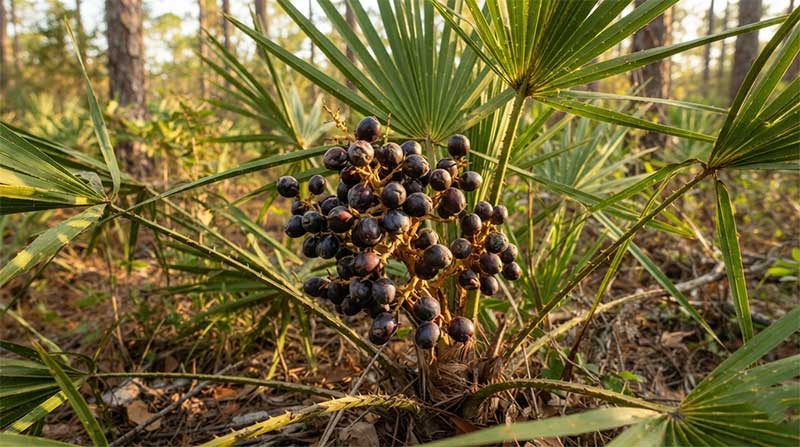
Benign prostatic hyperplasia, or BPH, is a non-cancerous enlargement of the prostate gland that becomes increasingly common with age, eventually affecting a majority of men by their sixties and seventies. It causes a cluster of frustrating urinary symptoms - a weaker stream, difficulty starting or stopping urination, a persistent feeling of incomplete emptying, and frequent trips to the bathroom at night that disrupt sleep. Given how common and how bothersome these symptoms are, it's not surprising that a low-cost, over-the-counter option derived from the berries of a small palm tree native to the southeastern United States became one of the most widely used herbal remedies in the world. Saw palmetto climbed to become the fifth most commonly consumed medicinal herb in the US, and in several Western European countries it's actually recommended as first-line therapy for BPH, ahead of some prescription options. That's not a fringe supplement story. That's mainstream, physician-endorsed use at genuine scale.

How the Early Evidence Built That Reputation
The foundation for saw palmetto's popularity wasn't built on nothing. Through the 1990s and into the early 2000s, a substantial number of clinical trials were conducted, and when researchers pooled the results together in meta-analyses, the picture looked genuinely encouraging. Two separate meta-analyses combining 18 randomized, placebo-controlled studies found that saw palmetto treatment, sustained for at least 30 days, produced real improvements in urologic symptoms and urinary flow measurements, with side effects that were consistently mild and infrequent. A later, more targeted analysis focusing on 11 randomized trials specifically found significant improvement in peak urinary flow rate and a reduction in nocturia - the nighttime bathroom trips that are often the most disruptive symptom for patients.
It's worth pausing on why this early, encouraging body of evidence turned out to be less reliable than it looked, because the explanation is instructive well beyond saw palmetto itself. Most of these individual trials were small, often enrolling only a few dozen participants, and many had real methodological weaknesses - inconsistent BPH severity criteria between studies, short follow-up periods, and varying extraction methods and doses that made direct comparison difficult. The authors of the meta-analyses themselves were honest about this, explicitly calling for further research using standardized preparations before saw palmetto's long-term effectiveness could be considered settled. There's also a well-documented feature of BPH research generally that complicates everything: somewhere between 30% and 50% of BPH patients report symptom improvement after taking a placebo, and that improvement rate is roughly the same even with simple monitoring and no treatment at all. When a condition has that strong a placebo response built in, small trials become genuinely bad at distinguishing a real drug effect from noise - which is exactly the situation saw palmetto's early evidence base was working within.

The Trial That Changed the Picture
Recognizing exactly this problem, the National Institutes of Health funded what would become one of the most methodologically careful herbal supplement trials ever conducted for a single condition. Researchers designed a double-blind, placebo-controlled, year-long randomized trial specifically to address the weaknesses that had limited confidence in the earlier smaller studies - a genuinely large, well-powered sample; a full year of follow-up rather than a few weeks or months; and both subjective symptom scores and objective measurements of urinary function tracked together, so the result couldn't hinge entirely on self-report in a condition already known for a strong placebo response.
If the story had ended there, it would already be a fairly clear-cut case. But researchers reasonably asked a follow-up question: what if the standard dose used in that trial simply wasn't strong enough? Saw palmetto's proposed mechanism of action - inhibiting the enzyme 5-alpha-reductase, the same target as the prescription drug finasteride - suggested that a higher dose might succeed where the standard one hadn't. The NIH and the National Center for Complementary and Integrative Health jointly funded a second trial specifically to test this possibility, giving some participants up to three times the usual dose. It did not improve BPH symptoms either. Researchers also specifically tested whether saw palmetto products prepared using hexane extraction - a manufacturing method some had suggested might yield a more potent, effective extract - performed any differently than products made using other extraction methods. They found no difference between the two. Between the dose question and the extraction-method question, two of the most common explanations offered for why earlier positive trials didn't replicate in the more rigorous research were tested directly and neither one panned out.
The National Center for Complementary and Integrative Health's most recent comprehensive review, examining 27 studies including both of the NIH-funded trials described above, reaches a clear and current conclusion: saw palmetto, when taken alone, provides little or no benefit for BPH symptoms. This isn't an outlier opinion or a single skeptical voice - it's the considered summary of the best available evidence as it stands today, built specifically from the trials designed to overcome the limitations of the earlier, more encouraging research.
Why the Proposed Mechanism May Never Have Fully Made Sense
There's a deeper, more mechanistic reason worth understanding here, because it helps explain why saw palmetto's early promise may have been built on a slightly shaky theoretical foundation from the start, independent of how the clinical trials eventually turned out. The leading hypothesis for how saw palmetto might help BPH was that it inhibits 5-alpha-reductase, the enzyme responsible for converting testosterone into dihydrotestosterone (DHT) - the hormone most directly implicated in prostate tissue growth. This is exactly the mechanism through which the prescription drug finasteride works, and finasteride's effect can be reliably measured: it produces a clear, consistent, measurable drop in serum DHT levels.
Saw palmetto doesn't reliably do this. Multiple investigators have looked for the same clear reduction in circulating DHT that finasteride reliably produces, and the evidence has been genuinely inconsistent - some studies finding modest local effects in prostate tissue, others failing to find the systemic hormonal signature you'd expect if this really were the operative mechanism at meaningful doses. Patent literature on saw palmetto extracts from companies that have spent decades studying it are notably candid about this uncertainty, acknowledging that saw palmetto "clearly does not behave the same as finasteride" and that the actual mechanism of action remains genuinely unclear, with different investigators presenting evidence for and against several competing explanations. When a proposed mechanism doesn't clearly show up where you'd expect it, and the resulting clinical trials don't show the benefit that mechanism would predict, the two findings actually fit together consistently - they're two different lines of evidence pointing toward the same honest conclusion, rather than one contradicting the other.
Where a Narrower Role Might Still Exist
None of this means every question about saw palmetto is closed, and it would be its own kind of overcorrection to treat "doesn't help standard BPH symptoms as a standalone treatment" as the final word on everything the plant has ever been studied for. A few areas deserve a more careful, separate look.
Chronic Prostatitis / Chronic Pelvic Pain Syndrome
A systematic review of 21 studies covering 1,666 patients found saw palmetto provided real symptom relief for chronic prostatitis and chronic pelvic pain syndrome - a related but distinct condition from BPH. Monotherapy showed some benefit over placebo, but the extract appeared most effective when combined with other treatments rather than used alone.
Beta-Sitosterol-Enriched Extracts
Newer extraction methods producing saw palmetto oil with substantially higher beta-sitosterol content (3% versus the conventional 0.2-0.3%) have shown superior efficacy in animal models of BPH, and one small placebo-controlled human trial reported improved outcomes with the enriched extract compared to conventional saw palmetto oil - genuinely promising, but still early, preliminary evidence that hasn't been tested at the scale of the trials that overturned saw palmetto's original BPH reputation.
Androgenetic Alopecia (Topical Use)
A small trial of a topical saw palmetto lotion in 20 men over 12 weeks found a significant increase in hair count and high participant satisfaction - an interesting, mechanistically plausible finding given saw palmetto's proposed anti-androgen properties, though the trial was small and needs replication before it can be considered established.
Chronic Pelvic Pain as Monotherapy
A separate, more focused 2022 review of five studies specifically on saw palmetto for chronic prostatitis/chronic pelvic pain syndrome did not find a significant standalone benefit - a reminder that even the more encouraging pelvic pain findings above are stronger in combination than alone.
A Practical Approach
Making Sense of This for Your Own Decision
Dosing
| Use Case | Studied Dose | Notes |
|---|---|---|
| BPH (as studied, standard dose) | 160mg twice daily, standardized extract | Reflects the dose used in the landmark year-long NEJM trial that found no benefit over placebo |
| BPH (as studied, high dose) | Up to 3x the standard dose | Tested in a follow-up NIH-funded trial; also found no benefit over placebo |
| Chronic prostatitis / pelvic pain (as studied) | Varies by trial; most effective as an add-on | Reflects the trials included in the 21-study systematic review; discuss combination approaches with a urologist |
Across its extensive clinical trial history, saw palmetto has consistently shown a favorable safety profile, with mild and infrequent side effects, most commonly mild gastrointestinal upset. It's generally considered one of the better-tolerated herbal supplements studied for any condition. That said, given the availability of established, better-evidenced treatments for BPH, and given that BPH symptoms can occasionally overlap with more serious urinary or prostate conditions, anyone experiencing new or worsening urinary symptoms should be evaluated by a physician rather than self-treating with saw palmetto or any supplement alone.
What It Stacks Well With
Urologist Evaluation
The most valuable first step for anyone with BPH symptoms - ensuring symptoms are properly evaluated and established, better-evidenced treatments are considered alongside any supplement interest.
Combination Approaches for Pelvic Pain
The chronic prostatitis/pelvic pain evidence specifically supports saw palmetto as an add-on to other treatments, not a standalone approach.
Realistic Expectations
Understanding what the rigorous trials actually found helps set a fair, evidence-based expectation rather than one built on older marketing claims.
New or Worsening Urinary Symptoms (See a Doctor)
Self-treating new symptoms with a supplement alone, rather than getting evaluated, risks delaying diagnosis of a more serious underlying issue.
Anticoagulant Medication (Caution)
Some evidence suggests a mild effect on bleeding parameters - mention saw palmetto use to your physician if you're on blood-thinning medication, particularly before surgery.
Relying on Higher Doses for Better Results (Caution)
The specific NIH-funded trial testing triple the standard dose found no additional benefit - more isn't a reliable workaround here.