I am 48, male and work as a nutritionist. I have been studying supplements professionally for years - and I still spent months taking the wrong things at the wrong times, doubling up on overlapping compounds, and wondering why my protocol felt like a part-time job.
The turning point was not finding a better supplement. It was building a better system. This article is about that system - the five steps I used to go from a chaotic collection of bottles to a protocol I actually follow every day without thinking about it.
I am sharing my specific stack as a concrete example - but the method is what matters. Your goals, your schedule and your biochemistry are different from mine. Use this as a template, not a prescription.

The Five Steps
Define your goals - specifically
Not "I want to be healthier." That is too vague to build a protocol around. The question is: what biological systems do you most want to support, and what is your timeline? Longevity and cellular maintenance require different compounds than acute cognitive performance or immune resilience. My goals were specific: slow mitochondrial decline, support glutathione as I age, maintain cognitive sharpness, protect connective tissue, and manage blood sugar stability. Each goal maps to a category of supplements. Without this clarity, you end up buying whatever sounds impressive.
Research your candidates
For each goal, identify the compounds with the strongest evidence. This is where AI becomes genuinely useful - not as a replacement for scientific judgment, but as a research accelerator. I use AI to scan recent literature, surface relevant clinical trials and identify mechanistic connections between compounds. What would take me three days in PubMed takes a few hours. The rule I follow: AI generates the shortlist, I verify every specific claim at the original source before it goes in the protocol. No blind trust in summaries.
Eliminate redundancy
This step alone has saved me more money than anything else. Once you have a longlist, you will find overlaps - compounds hitting the same pathways, precursors and end products taken simultaneously, or combinations where one negates the other. NR and NMN together. Resveratrol and pterostilbene at full dose. Multiple high-dose antioxidants that compete for absorption. Before your protocol is final, run a redundancy check. We have an entire article dedicated to this topic that I strongly recommend reading at this point.
Optimize timing around your real schedule
The best protocol is the one you actually follow. Supplement timing matters - some compounds need fat for absorption, some are stimulating and should not be taken in the evening, some compete for the same transporters and should be separated. But all of this is irrelevant if the timing means you skip doses. Map the timing to your actual daily rhythm, not an ideal one. I work four days per week and commute - so anything that needs to be refrigerated, taken fresh or requires a specific meal context gets assigned to those conditions, not added as a vague "take with food."
Write the plan and build physical systems
Print the plan and keep it with your supplements. Not on your phone - printed, next to the bottles. When you are half-asleep at 7am reaching for your morning portion, you do not want to be unlocking a screen. The plan should show: each portion, what goes in it, the dose, whether it is daily or cycled. Once it is printed and working, the physical organization systems take over and the cognitive load drops to almost zero.
My Goals - What I Am Actually Trying to Achieve
Longevity & Cellular Maintenance
NAD+ pathway, autophagy, senolytic support, mitochondrial function
Cognitive Sharpness
Acetylcholine support, neuroplasticity, sustained focus without crash
Antioxidant Defense
Glutathione system, NRF2 activation, heavy metal clearance
Energy & Metabolism
Mitochondrial efficiency, blood sugar stability, fat metabolism
Structural Integrity
Collagen synthesis, joint support, connective tissue maintenance
Sleep & Recovery
GABA/glycine balance, melatonin regulation, overnight repair
The Protocol - Five Daily Portions
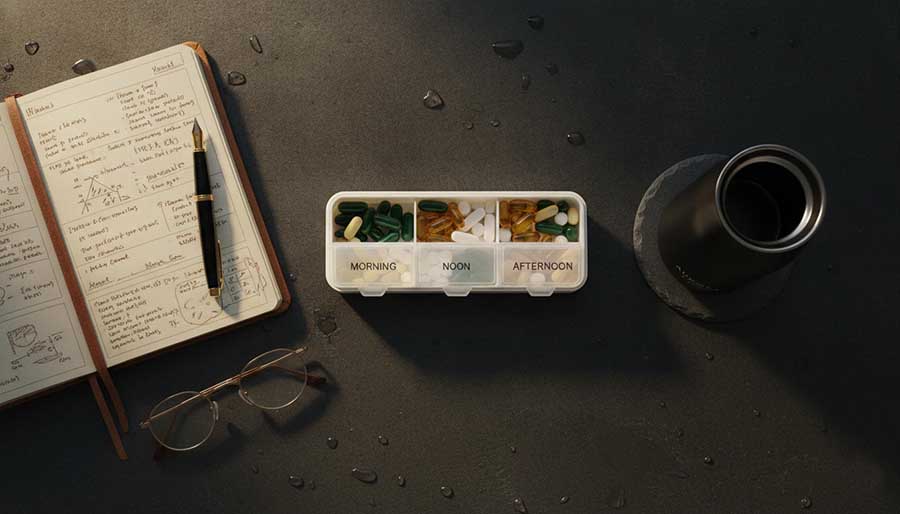
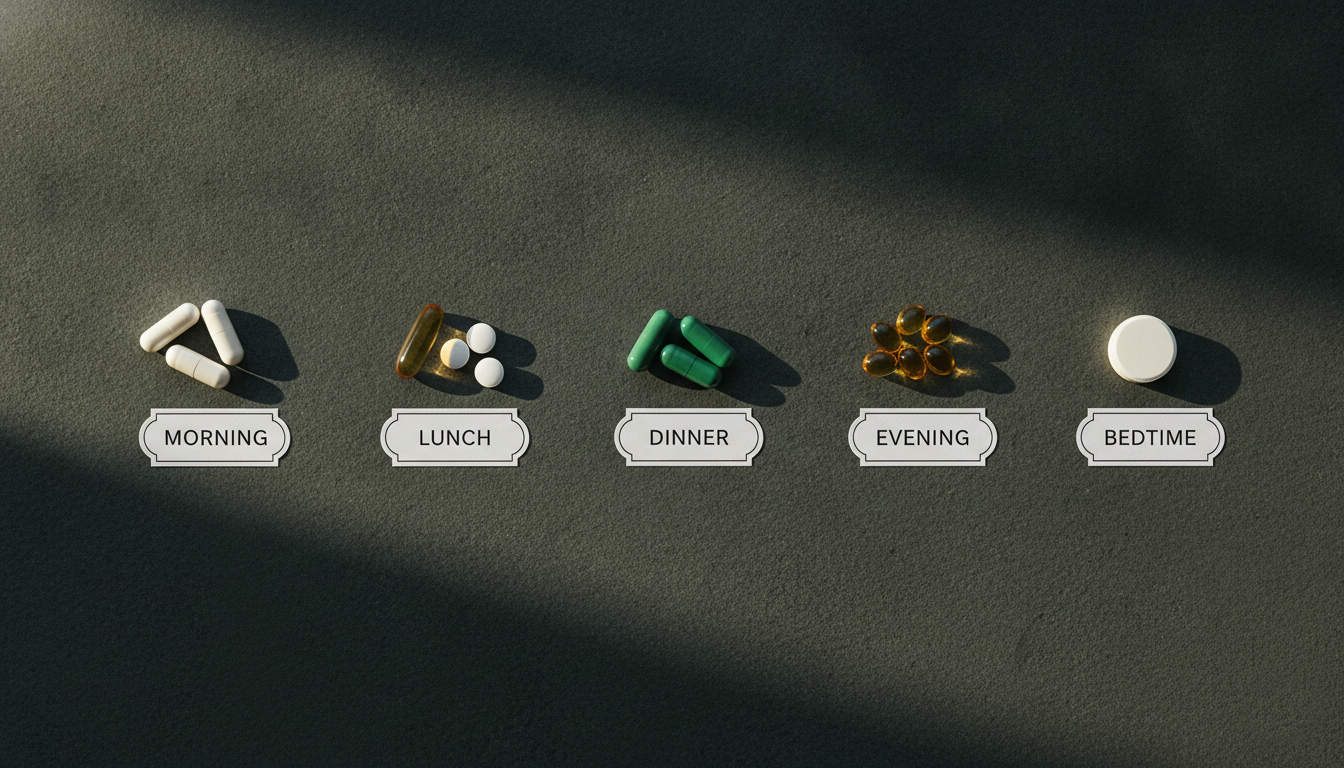
My stack is organized into five portions that map to five moments in my day. P1 and P5 I take at home. Portions P2, P3 and P4 travel with me in the pill organizer - they align with breakfast, lunch and afternoon, all of which happen away from home on workdays. Here is the full breakdown:
Three consecutive days per month I add high-dose Fisetin and Quercetin to P3, and Apigenin to P5. On pulse days, daily Quercetin and OPC are paused to reduce oxalate load on the kidneys. This is a separate protocol layered on top of the daily stack - not a daily practice.
The Organization Systems That Make It Sustainable
The protocol above looks complex on paper. In practice it takes about three minutes in the morning and two at night. That is because of three physical systems that eliminate almost all decision-making from the process.
System 1: The Two-Day Pill Organizer
I use a large pill organizer with six compartments - enough for two full days of P1, P2 and P3. P4 and P5 I take at home so they do not need to travel. On Sunday evening I fill the organizer for the coming two days. It takes about eight minutes. For the rest of those two days, there are zero decisions to make about supplements during the workday - I just open the right compartment at the right time.
Look for a pill organizer with at least 3 compartments per day and two days capacity. The larger compartments accommodate bigger capsules and multiple tablets without jamming. A hard case that fits in a work bag is worth the small extra cost.
System 2: Labeled Supplement Lids
Every supplement bottle in my stack has a label on the lid with three pieces of information: the number of capsules per dose, the time of day to take it, and whether it is daily or cycled. I use a simple code: T for täglich (daily), C for Cycle.
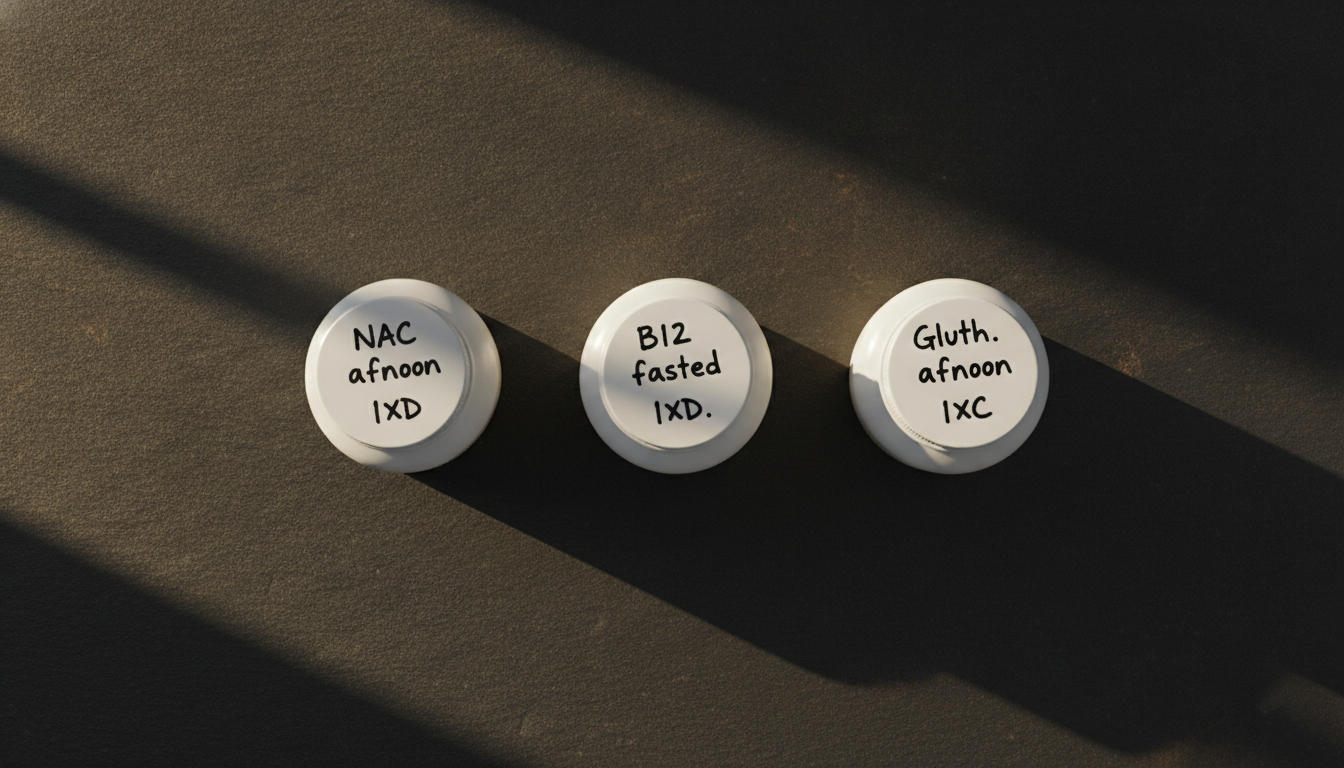
When I need to refill the organizer, I do not need to remember anything - I just read the lid. When I am deciding whether to take something during an off-cycle week, the C on the lid reminds me immediately. This sounds trivial, but it eliminates a surprising amount of mental friction over months of consistent use.
System 3: The Printed Plan
Print the plan. Not as a PDF on your phone - printed on paper, next to your supplements. The plan should show all five portions, what goes in each, the dose, and the cycling schedule. When you are filling the organizer on Sunday evening, the plan is right there. When someone in your household asks what you are taking and why, you hand them the paper.
Laminate the printed plan or put it in a plastic sleeve. It lives next to the supplement storage permanently. Update it when your protocol changes and print a new version - do not try to maintain a handwritten version over time.
On Using AI in This Process
I use AI - specifically Claude - as a research accelerator throughout steps 1 and 2. Not to decide what I take, but to process large volumes of research faster than I could manually. A typical session: I describe my goal, ask for the compounds with the strongest evidence for that specific outcome, and then ask it to identify potential interactions or timing conflicts with what I already take.
The AI draws on thousands of studies simultaneously and can identify mechanistic connections that would take hours to surface manually. It also catches things I might miss - like the copper-zinc antagonism that moved my copper supplementation to a separate portion from my zinc, or the biotin depletion that long-term ALA use can cause.
The non-negotiable rule: every specific claim the AI makes gets verified at the original source before it goes into the protocol. AI summaries are a starting point, not a conclusion. This is how we work across all ARI content - and it is how I work with my own stack.