Every supplement review on this site eventually runs into the same interpretive problem: a study "shows" a compound does something, but the study was done in mice, or rats, or a petri dish, and the question of whether that finding says anything meaningful about a human taking a capsule is left hanging. This is worth addressing directly and at length, because the honest answer is genuinely "it depends" - and the two clearest cases in modern medical history, one where the translation worked about as well as it possibly could, and one where it failed catastrophically, show exactly what that "it depends" actually depends on.
When It Worked: Insulin and the Fastest Translation in Medical History
In May 1921, Frederick Banting and Charles Best began tying off the pancreatic ducts of laboratory dogs at the University of Toronto, waiting for the enzyme-producing tissue to degenerate while leaving the insulin-producing islet cells intact. Progress was slow and often grim - seven of their first ten dogs died before they had anything to show for it - but by December of that year, they had an extract that reliably lowered blood sugar in dogs whose pancreas had been surgically removed, the standard animal model of diabetes at the time.
When It Failed Catastrophically: Thalidomide and the Species That Didn't React
If insulin is the case for how well this can go, thalidomide is the case for how badly - and understanding exactly why is more useful than simply knowing that it happened.

Thalidomide was marketed from the late 1950s as a sedative and anti-nausea treatment, including for morning sickness in pregnant women, and was considered remarkably safe - it didn't produce toxic effects in adult animals even at very high doses. What nobody had adequately tested was its effect on a developing fetus. By the early 1960s, it became clear the drug was responsible for an estimated 10,000 cases of severe limb and organ malformations in babies born to mothers who took it during pregnancy.
The uncomfortable detail, confirmed by extensive retrospective testing across roughly 10 rat strains, 15 mouse strains, and 11 rabbit breeds, is that thalidomide induces teratogenic effects only occasionally across the vast majority of species and strains tested - and where it does, the doses required and the specific malformations produced vary enormously. Standard laboratory rats and mice, the default species used for drug safety testing at the time, are largely resistant to thalidomide's teratogenic effects. New Zealand White rabbits and primates are sensitive, but even in rabbits, reproducing the effect required doses 75 to 300 times higher than typical human exposure. This wasn't a case of researchers being careless or skipping steps - by the standards of the era, thalidomide had been through the animal testing considered appropriate at the time. The species chosen for that testing simply didn't get sick the way people did.
Why Species Differences Happen: Metabolism, Not Just Anatomy
It's tempting to assume species differences come down to obvious anatomical facts - a mouse liver is smaller, a mouse heart beats faster - but the thalidomide case reveals something more specific and more broadly useful to understand: the differences that matter most are often about how a drug is metabolized, not just what it looks like when it's built.
Rodents Metabolize It Away Too Fast
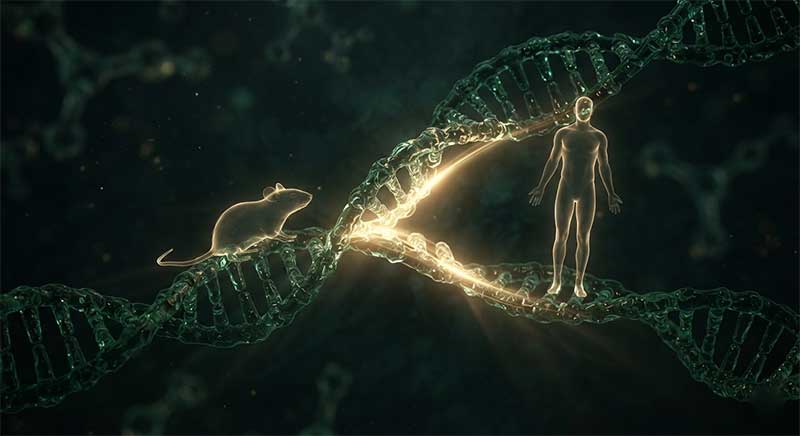
Research comparing species found the maternal metabolism of thalidomide is extremely high in rodents compared to humans - the drug is broken down and cleared so quickly that very little of the unchanged compound actually reaches the developing embryo, sharply limiting any chance for a teratogenic effect to occur.
Humanized Mice Finally Reproduced It
Researchers eventually created genetically modified mice carrying human CYP3A liver enzymes in place of the mouse version. In these "humanized" mice, thalidomide produced the characteristic limb abnormalities seen in humans - direct experimental confirmation that the specific enzyme responsible for human-relevant metabolism, not some vaguer species difference, was the missing piece all along.
This is a genuinely important detail buried in the thalidomide story: the failure wasn't that "animal testing doesn't work." It's that the specific rat and mouse strains used happened to process this specific drug through a different metabolic route than humans do, in a way nobody had reason to suspect in advance. Once researchers built mice with human-equivalent liver enzymes, the same species that had been "resistant" for decades suddenly showed the same effect seen in people - which is exactly the kind of detail worth checking for, in principle, whenever a supplement or drug claim rests entirely on standard rodent data.
The Numbers: How Often Does Animal Data Actually Predict Human Outcomes?
Stepping back from these two specific cases, it's worth knowing what the aggregate statistics actually say - not the frequently repeated "90% of animal-tested drugs fail in humans" one-liner alone, but what's underneath it.
Roughly 12% of drug candidates that pass preclinical (largely animal) testing go on to enter human clinical trials at all, and of those that do, overall approval rates remain low - commonly cited figures put total success from Phase 1 trial entry to approval around 12%, meaning roughly 90% of drugs that made it past animal testing still fail somewhere in the human trial process. But this failure rate is not remotely uniform: it runs closer to 35-40% success for eye treatments and vaccines, and below 8% for cancer treatments specifically - a difference driven mainly by how well animal models capture the complexity of a given disease, not by animal testing failing uniformly across the board. Separately, a widely cited analysis of 2,366 drugs found that toxicity results from rat, mouse, and rabbit testing were "little better than what would result merely by chance" at predicting human toxic responses - a genuinely uncomfortable finding, though defenders of the current system note that removing animal toxicity screening entirely would have let a meaningful share of genuinely dangerous compounds reach human Phase 1 trials.
A Third Case: When the Human Trial Itself Overturns the Plausible Rationale
Thalidomide is a story about a straightforward species-metabolism mismatch. But there's a second, subtler failure mode worth knowing about, because it doesn't even require a literal animal study to go wrong - it can happen when a genuinely reasonable biological rationale, well supported by observational and mechanistic data, still turns out to be false once it's actually tested in a randomized human trial.
Observational studies had repeatedly found that people who ate more beta-carotene-rich vegetables had lower lung cancer rates, and beta-carotene's antioxidant properties gave that association a plausible underlying mechanism - oxidative damage was understood to play a role in cancer development, and antioxidants were a reasonable candidate for interrupting it. Two large randomized controlled trials, the ATBC Study and CARET, tested high-dose beta-carotene supplements specifically in smokers to see if the association held up as an actual causal treatment. Instead of protection, both trials found significantly increased lung cancer incidence and overall mortality in the beta-carotene groups - an 18% and 28% increase in lung cancer cases, respectively. The mechanism wasn't crazy, and the observational data wasn't fabricated. The randomized trial - the type of evidence that actually tests cause and effect rather than just association - overturned a rationale that had looked entirely reasonable right up until it was tested properly. It's a useful companion case to thalidomide precisely because no cross-species metabolism error was involved at all; the human data itself simply didn't confirm what the plausible story predicted.
What Changed After Thalidomide
The thalidomide catastrophe didn't just end one drug - it rewrote the rules for how every new drug is tested before it ever reaches a pregnant woman, in a way that's directly traceable to the specific failure described above.
Regulatory guidelines adopted in the wake of thalidomide, still in force today, require that reproductive and developmental toxicity testing be conducted in two species - conventionally a rodent and a non-rodent, almost always the rabbit specifically because it's one of the few common laboratory species that does respond to thalidomide-like compounds. This rule exists for exactly the reason this article has walked through: a single species, chosen without knowing in advance whether its metabolism matches human metabolism for a given compound, can miss a catastrophic effect entirely. Testing two species with meaningfully different metabolic profiles doesn't guarantee catching every possible human-specific effect, but it substantially reduces the odds that one metabolic quirk in one species produces a false reassurance across the board.
A Practical Framework for Reading "Shown in Animal Studies" Claims
Questions Worth Asking Before Updating Your Beliefs
Which Species, and How Many?
A single-species finding carries less weight than the same result replicated across species with different metabolic profiles.
What Dose, Scaled How?
Animal doses don't translate to human doses on a simple weight basis - metabolic rate differences mean naive scaling is often wrong.
Same Metabolic Pathway in Humans?
Thalidomide shows this is often the single most important, and most overlooked, question.
Has It Been Tested in an Actual Human Trial?
Beta-carotene shows even a well-supported rationale can fail this specific test.
Which Disease Area?
Translation success varies from roughly 35-40% (eye disease, vaccines) to under 8% (cancer).
One Study, or a Consistent Body of Evidence?
A single animal study is a hypothesis; a consistent finding across independent labs and species is much stronger.