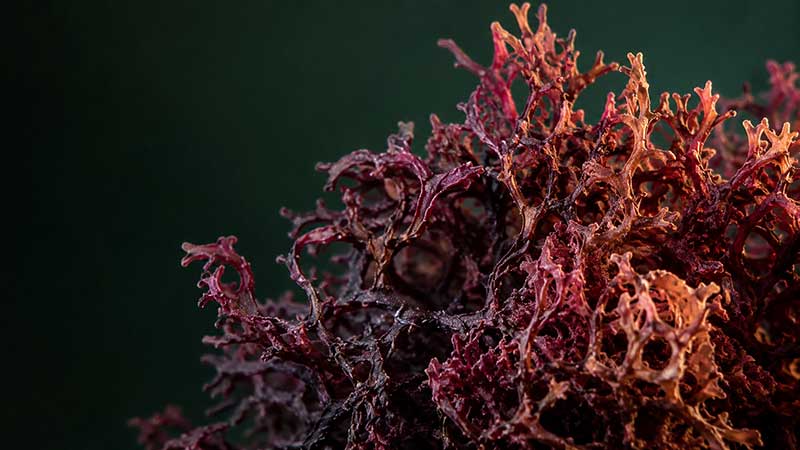
Sea moss has had one of the more remarkable trajectories of any wellness product in recent memory. A red algae traditionally harvested along Atlantic and Caribbean coastlines, used for generations in Irish and Caribbean folk medicine and, during the Irish famine, as an emergency food source, it has gone from a little-known regional ingredient to a global commercial category valued at roughly $2.18 billion in 2024, with projections putting it near $2.6 billion by 2030. Social media and celebrity endorsement did most of the heavy lifting - the plant itself didn't change; the audience did.
What makes sea moss worth a genuinely careful look isn't that it's nutritionally worthless - it isn't. It's that the specific claims built around it, and the specific risks glossed over in most of the coverage promoting it, both deserve more scrutiny than they typically get. This article works through both halves: the marketing number that doesn't hold up, and the actual, measured risks that get far less attention than they should.

The "92 Minerals" Claim, Traced to Its Source
If you've encountered sea moss marketing at all, you've seen this number. It appears on product labels, in TikTok captions, on wellness blogs, and in the copy of nearly every brand selling the stuff: sea moss contains 92 of the 102 minerals the human body needs. It's specific enough to sound like it came from a real study, and it's repeated widely enough that most people assume someone, somewhere, checked.
Nobody appears to have checked, at least not in the way the claim implies. Multiple independent nutrition writers and at least one physician-reviewed source have traced the number's likely origin and found it doesn't connect to any actual sea moss laboratory analysis. One plausible root is a decades-old confusion between the mineral content of seawater itself - which does contain trace amounts of nearly every naturally occurring element, since seawater is, chemically, an extraordinarily diverse solution - and the mineral content of sea moss as a food product, which is a different and much smaller question. Another likely contributing factor is a garbled reference to the periodic table, which contained 102 known elements decades ago (118 are now recognized), conflating "elements that exist in the ocean" with "minerals present in meaningful, biologically relevant amounts in a specific dried algae product."
When actual laboratory nutrient panels of sea moss are examined - the kind published by nutrition databases like the USDA's, rather than repeated on product pages - the real picture is a meaningful but far more modest list: somewhere in the range of 15 to 20 minerals present in measurable, significant amounts, including iodine, potassium, magnesium, calcium, iron, zinc, and selenium, alongside a broader scatter of trace elements at levels too small to carry clear nutritional significance. That's a genuinely respectable mineral profile for a food - it's just not 92, and continuing to state it as though it were is, at minimum, a sign that a brand isn't prioritizing factual accuracy in the rest of its marketing either.
It's worth being fair here: sea moss being mineral-rich isn't the myth. Algae genuinely do absorb dissolved minerals directly from the water they grow in, across their entire surface, rather than through a root system the way land plants draw from soil - a real biochemical difference that does tend to make seaweeds nutritionally denser in certain minerals than equivalent land vegetables. The myth is specifically the number, and specifically the implication that it's been verified. A food can be genuinely nutrient-dense without needing an invented statistic to prove it, and the fact that sea moss marketing has leaned so heavily on an unverifiable figure for years is itself a useful signal about how much scrutiny the rest of the category's claims have received.
The Real Risk: Iodine You Genuinely Cannot Predict
This is the part of the sea moss conversation that deserves far more attention than the mineral-count debate, because unlike the "92 minerals" claim, the iodine issue isn't a matter of misleading marketing copy - it's a matter of measured, documented, and genuinely alarming product variability that has real physiological consequences.
The physiological consequences of this unpredictability are not theoretical. Excess iodine intake can push thyroid function in either of two opposite directions, both well-documented in the endocrinology literature: the Wolff-Chaikoff effect, in which the thyroid temporarily shuts down hormone production in response to an iodine surge, and the Jod-Basedow effect, in which excess iodine triggers overproduction of thyroid hormone, particularly in people with pre-existing thyroid nodules or a history of iodine deficiency. A 2018 case series published in Endocrinology, Diabetes & Metabolism documented real, clinically confirmed thyroid dysfunction in patients who had been regularly consuming seaweed supplements - not a hypothetical risk extrapolated from mechanism, but an actual observed clinical outcome.
The Drugs and Lactation Database (LactMed) specifically documents that maternal consumption of excess iodine from seaweed has caused thyroid suppression in breastfed infants, and recommends sea moss be avoided during breastfeeding unless the iodine and heavy metal content of the specific product has been independently verified as low enough to be safe - a standard that, given the labeling accuracy problems described above, is genuinely difficult for an individual consumer to meet on their own.
Heavy Metals: A Second, Independently Confirmed Risk
Separate from the iodine question, sea moss carries a second, mechanistically distinct risk that comes from the same biological property that makes it mineral-rich in the first place: algae absorb whatever is dissolved in the water around them, indiscriminately, which means contaminants accumulate right alongside beneficial minerals. Arsenic, lead, cadmium, and mercury are all naturally present in seawater at low background levels, and algae grown in more polluted coastal waters can concentrate these to levels of genuine public health concern.
Inorganic Arsenic
A 2020 analysis in Food and Chemical Toxicology tested 10 commercially available seaweed products and found inorganic arsenic levels in several that exceeded recognized safe daily intake thresholds.
Cadmium and Lead
Independent testing has found powdered sea moss products (the capsule form) containing cadmium and lead at levels exceeding limits set by California's Proposition 65 regulatory framework.
EFSA Risk Assessment
The European Food Safety Authority conducted a formal 2023 assessment of heavy metal and iodine exposure via seaweed consumption across the European population, reflecting that regulators now treat this as a genuine, quantifiable public health question rather than a fringe concern.
Cumulative Exposure Risk
Research published in 2025 confirmed that seaweed consumption causing heavy metal accumulation is associated with kidney dysfunction, neurological damage, and increased cancer risk at high, sustained intake levels.
It's worth being precise about what this does and doesn't mean in practice: not every sea moss product is contaminated, and not every source region carries equal risk. The exposure depends heavily on where and how the specific algae was harvested, and reputable manufacturers who test every batch for both iodine content and heavy metals, and disclose the results, are addressing exactly this concern directly. The problem is that this level of transparency is currently the exception rather than the rule in a market that grew explosively fast, driven largely by social media demand outpacing the manufacturing and testing infrastructure needed to keep up with it responsibly.
In January 2026, a sea moss gel brand was recalled by the FDA after a state health inspection found the product lacked proper pH monitoring and regulatory authorization - a food-safety issue distinct from the nutrient and contamination questions above, related to how moist, low-acid gel products need specific processing controls to prevent bacterial growth. It's a useful, recent reminder that sea moss has moved from folk remedy into a commercially manufactured food category subject to the same kinds of production risks as any other packaged product - risks that don't disappear just because something is marketed as natural.
What the Actual Evidence Supports
None of the above means sea moss is without any legitimate use - it means the legitimate uses are narrower and more specific than the marketing suggests, and much of what gets cited as "sea moss research" is, on closer inspection, general seaweed research being applied by association rather than evidence generated on sea moss itself.
| Claimed Benefit | Evidence Quality | Notes |
|---|---|---|
| Prebiotic fiber / gut health | Reasonably supported | Sulfated polysaccharides (carrageenans) genuinely feed beneficial gut bacteria - one of the better-supported claims for sea moss specifically |
| Iodine source for deficient individuals | Genuinely useful, if dosed carefully | Relevant for people avoiding dairy, seafood, and iodized salt - but requires knowing the actual iodine content of the specific product, which is often unclear |
| Topical skin hydration | Some support | The gel's mucilaginous texture has genuine humectant properties for topical use, independent of the ingestion-related concerns above |
| Immune support, thyroid "optimization," general vitality | Thin, mostly borrowed | Largely extrapolated from general seaweed research rather than sea moss-specific human trials; high-quality supporting evidence is limited |
A Practical Quality Checklist
Before You Buy Sea Moss
Dosing
| Form | Typical Amount | Notes |
|---|---|---|
| Gel (raw) | 1 - 2 tablespoons/day | Iodine and mineral content varies enormously by batch and source - no standardized dose exists |
| Capsules / powder | Per manufacturer label | Only meaningful if the product includes a verified certificate of analysis; label claims alone are unreliable |
People with thyroid disorders (hyperthyroidism, hypothyroidism, Hashimoto's, or Graves' disease), kidney disease, or those on blood thinners (sea moss contains vitamin K, which can interfere with warfarin specifically) or thyroid medications should avoid sea moss or use it only under direct medical supervision. Pregnant and breastfeeding individuals should avoid it given documented cases of iodine-related infant thyroid suppression. Given the genuine, independently confirmed heavy metal and iodine variability described throughout this article, sea moss is a supplement category where sourcing transparency matters more than for almost any other product on this site.
What It Stacks Well With
Probiotics
Sea moss's prebiotic polysaccharide content may complement probiotic supplementation - one of its better-supported use cases.
Independent Lab Testing
The single most valuable "addition" to any sea moss purchase - a verified certificate of analysis for iodine and heavy metals.
Thyroid Function Testing
If using sea moss regularly, periodic thyroid panel monitoring is a reasonable precaution given the documented, unpredictable iodine load.
Warfarin / Blood Thinners (Caution)
Sea moss's vitamin K content can interfere with warfarin specifically - close monitoring is required if combined.
Thyroid Medication (Caution)
Unpredictable iodine content can interfere with thyroid hormone replacement dosing - discuss with a physician before combining.
Untested Products (Caution)
The documented range of contamination and iodine variability makes an untested product a meaningfully higher-risk purchase than most supplements on this site.